
Bago sa HK? Bakit ang Mabilis na Pag-oo ay Pwedeng Magdulot ng Malaking Misunderstanding
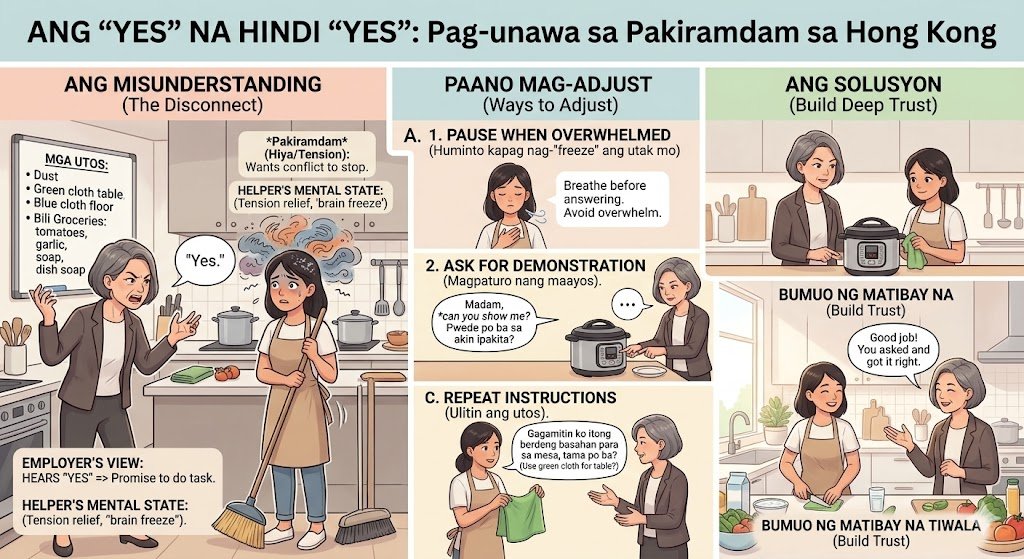
🇵🇭✈️🇭🇰 Maligayang pagdating sa Hong Kong! Normal lamang na makaramdam ng pagkabigla sa iyong mga unang linggo rito. Napakabilis ng takbo ng buhay sa HK, at kung minsan, ang iyong amo (employer) ay pwedeng magtunog malakas, nagmamadali, o stressed kapag nag-uutos.
Bilang mga Pilipino, likas sa atin ang gumamit ng Pakiramdam—sinusubukan nating basahin ang emosyon sa paligid para panatilihin ang kapayapaan. Kaya kapag ang galit o stressed na amo ay nagtanong ng, "Do you understand?!" (Naiintindihan mo?!), napapakapit tayo sa mabilis na pagsagot ng, "Yes, Madam," para lamang patigilin ang tensyon at humupa ang init ng ulo.
Ngunit narito ang katotohanan sa kultura ng Hong Kong na dapat mong matutunan:
Para sa iyo: Ang "Yes" ay nangangahulugang, "Naririnig kita, nakikita kong stressed ka, at ayaw ko na ng pagtatalo."
Para sa iyong HK employer: Ang "Yes" ay may iisang ibig sabihin lamang, "Naintindihan ko nang buong-buo ang utos mo at ipinangangako kong gagawin ko ito nang eksakto sa paraang sinabi mo."
Kung mag-"Yes" ka para lang matapos ang usapan, ngunit magkakamali ka naman sa task dahil hindi mo talaga naproseso ang utos, hindi ito maiintindihan ng amo mo. Maaaring isipin nilang ikaw ay tamad o nagsisinungaling—kahit ang totoo ay sinusubukan mo lang naman maging magalang! Sa Hong Kong, mas pinahahalagahan ng mga employer ang direktang katotohanan at magandang resulta kaysa sa pagpapanatili ng hiya.
Paano Mag-adjust: 3 Hakbang Para Maiwasan ang "Yes" Trap
Huwag matakot na makipag-communicate! Sa Hong Kong, ang pagtatanong ay hindi kawalan ng galang—ito ay patunay na interesado ka at gusto mong magawa nang tama ang iyong trabaho.
Huminto kapag nag-"freeze" ang utak mo: Kung sumisigaw o nagmamadali ang amo mo, normal lang na mag-blanko ang isip mo dahil sa kaba. Huminga nang malalim bago sumagot.
Magpaturo nang maayos (Demonstration): Kung hindi ka sigurado sa pinapagawa, sabihin nang magalang: "Madam/Sir, I want to make sure I do this exactly the way you want. Can you please show me how you like it done?" (Gusto ko po sanang masiguro na magagawa ko ito nang tama. Pwede niyo po ba sa akin ipakita kung paano niyo ito gustong gawin?)
Ulitin ang utos para makasiguro (Teach-Back): Bago mo simulan ang trabaho, kumpirmahin ito sa kanila. Halimbawa: "Just to be sure, you want me to use this green cloth for the table and the blue cloth for the toilet, correct?" (Para masiguro ko lang po, gagamitin ko itong berdeng basahan para sa mesa at ang asul para sa banyo, tama po ba?)
Kailangan ng lakas ng loob na sabihing, "Hindi ko pa po masyadong naintindihan," ngunit ito ang magliligtas sa iyo sa pagkakamali at magtatayo ng matibay na tiwala (trust) sa iyong amo sa katagalan!
My helper moves like a SNAIL
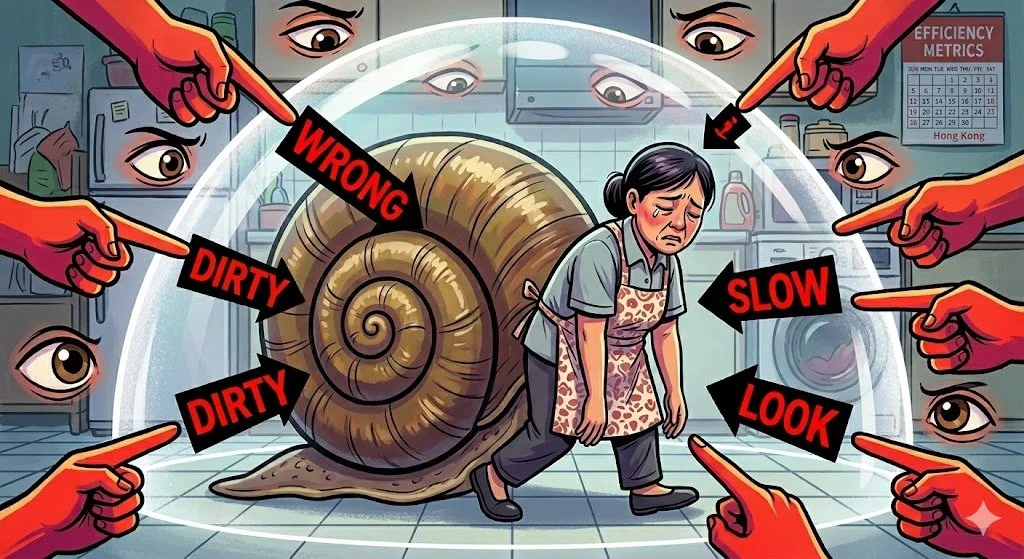
How Hiya (Shame) Causes Paralysis Rather Than Speed
It is a scenario many Hong Kong employers know well: you notice your new helper making a mistake—perhaps she forgot to close the toilet lid before flushing, or she mixed up the ingredients for the baby’s porridge, and desperate to keep your household running on time, you correct her quickly, perhaps with a raised voice or an intense tone.
You expect her to move faster to fix it. Instead, the exact opposite happens. She slows down to a crawl, moving like a snail, or freezes entirely.
To a results-oriented Hong Kong mindset, this looks like laziness, defiance, or a lack of care. But beneath the surface, a powerful cultural dynamic is at play: Hiya.
Understanding the Psychology of Hiya
In Filipino psychology, Hiya is often translated as "shame," but it is much deeper than that. It is a profound sense of social propriety and dignity. When a helper is repeatedly or sharply corrected, she doesn't experience it as a simple "performance review." She experiences it as a deep, painful wound to her standing in the household.
When Hiya is triggered by a stressed employer, the helper's natural psychological defense mechanism is not to accelerate—it is to freeze.
The Fear of the Next Mistake: Under the weight of Hiya, a helper becomes terrified of making another mistake that will bring more shame.
Cognitive Overload: Her brain enters a state of Tulala (blankness or shock). She is double-thinking every single move—how she holds the knife, where she places the cloth—to the point where her physical speed drops significantly.
The Irony of Pressure: The more an employer hovers, checks, and criticizes to force speed, the more intense the Hiya becomes, slowing the helper down even further.
🧠 Thought Question for Employers
Look at your current interaction style. When your helper slows down or makes a seemingly obvious mistake after being taught, are you watching her every move? Is it possible that your proximity and anxious energy are actually triggering the very paralysis you are trying to fix?
🛠️ Action Points for the Hong Kong Home
To break the cycle of Hiya-induced paralysis and get your household back up to speed, try shifting from verbal pressure to structured systems:
Step Back to Speed Up: If you notice her freezing, physically leave the room for a few minutes. Give her the emotional space to reset her brain without feeling watched.
Use the "Paper Boss" (Checklists): Instead of verbally tracking her ("Where is the fish? Why is the floor wet?"), use a written daily schedule or rundown. Let her check items off on paper. This removes the emotional friction of face-to-face correction and gives her a sense of achievement rather than shame.
Praise Before You Correct: Protect her dignity. If you need to correct a mistake, start with one thing she did well that day. A helper who feels her dignity is intact will naturally move with more confidence and speed.
Why a "First-Time" Helper Might Be the Perfect Choice for Your Family
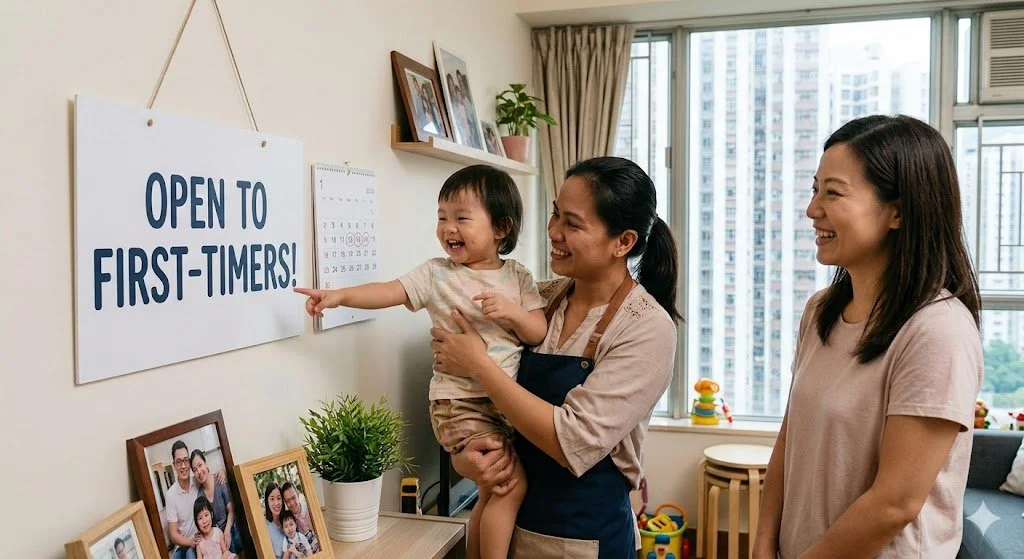
When looking for a Filipino domestic helper, many Hong Kong families only want to hire someone with "overseas experience." They worry that a first-timer will not adapt well or might leave early.
At Arrow, we want to share a different truth: First-time helpers are highly capable, reliable, and deeply committed.
Here is why you should consider welcoming a first-time helper into your home:
1. Great Motivation and Loyalty
For a first-timer, coming to Hong Kong is a life-changing opportunity to support their family. Because you are giving them their first big chance, they usually feel deep gratitude. This creates a very strong bond of loyalty and long-term commitment to your family.
2. No Comparison, Ready to Learn
Every Hong Kong home has its own rules and ways of doing things. Experienced helpers sometimes compare new employers to their old ones. A first-timer comes with a blank slate. They are eager to learn your cooking style, your schedule, and your preferences.
3. High Capability
"First time abroad" does not mean "no experience." Most of these applicants have raised their own children, cared for elderly relatives, or worked hard in the Philippines. They already have the necessary skills—they just need a welcoming home to show them. There are no statistics showing that first-timers are more likely to quit than experienced helpers. Mothers who are coming to HK to support the education of their children ARE HIGHLY MOTIVATED because they want their children to graduate from university. They won’t give up easily!
❤️ Partner With Arrow: Get $1,000 Off Your Agency Fee
At Arrow, our mission is to help you find and keep a good helper. We want to support you in giving someone their first opportunity.
For a limited time, we are offering $1,000 off our agency fee if you choose to hire a qualified first-time overseas helper.
Don't miss out on wonderful talent. Let us help you find a dedicated helper who will care for your family with all their heart.
How to view our first-time applicants:
Click this link to go to our website: arrowes.hk/arrowbios
Look for the "Quick Match" section.
Click the button that says: 🌟 Open to first-timers
Click the what’sapp button under their bio to message Arrow to arrange an interview for you.
Once a helper gives you “30 days notice” she will NEVER take it back.
The Concept: Dangal (Dignity)
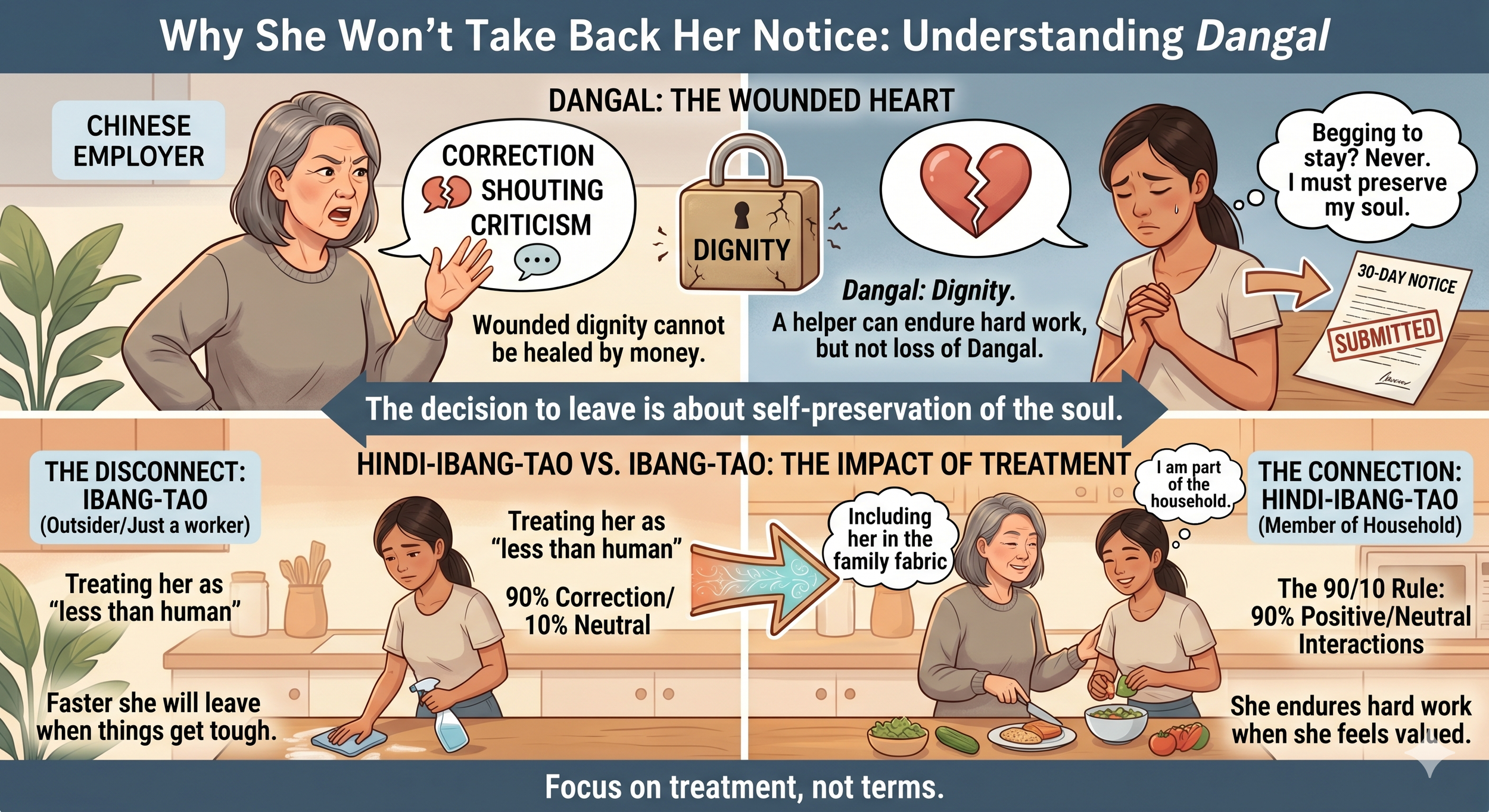
Arrow has been in business for around 20 years and in that time, I have tried many times to persuade a helper to give her employer another chance. “Just take back your 30 days notice! Give them another chance!” Guess how many times I have succeeded in changing their minds - ZERO, NADA, NEVER. I recently learned the reason - it’s called “Dangal” - DIGNITY. Here’s what I learned.
In Filipino culture, a person can endure hard work and long hours, but they cannot endure the loss of their Dangal (dignity). If a helper feels she has been shouted at or treated as "less than human" (Ibang-tao), her dignity is wounded. For her, taking back the notice is "begging," which is the ultimate loss of face. She feels she has already been treated as “less than human”. The resignation effectively reclaims some of her personhood, humanity. By the time she gives her notice she has passed the point of no return. Once the decision is made, it is a matter of self-preservation of the soul.
Thought Question: Is your helper a "member of the household" (Hindi-ibang-tao) or just a "worker" (Ibang-tao)? The more she feels like the latter, the faster she will leave when things get tough.
Action Point: Use the 90/10 Rule. Ensure 90% of your interactions are neutral or positive. If 90% of your talk is "correction," she will feel her Dangal is under constant attack.
The "Yes" That Doesn't Mean "Yes"
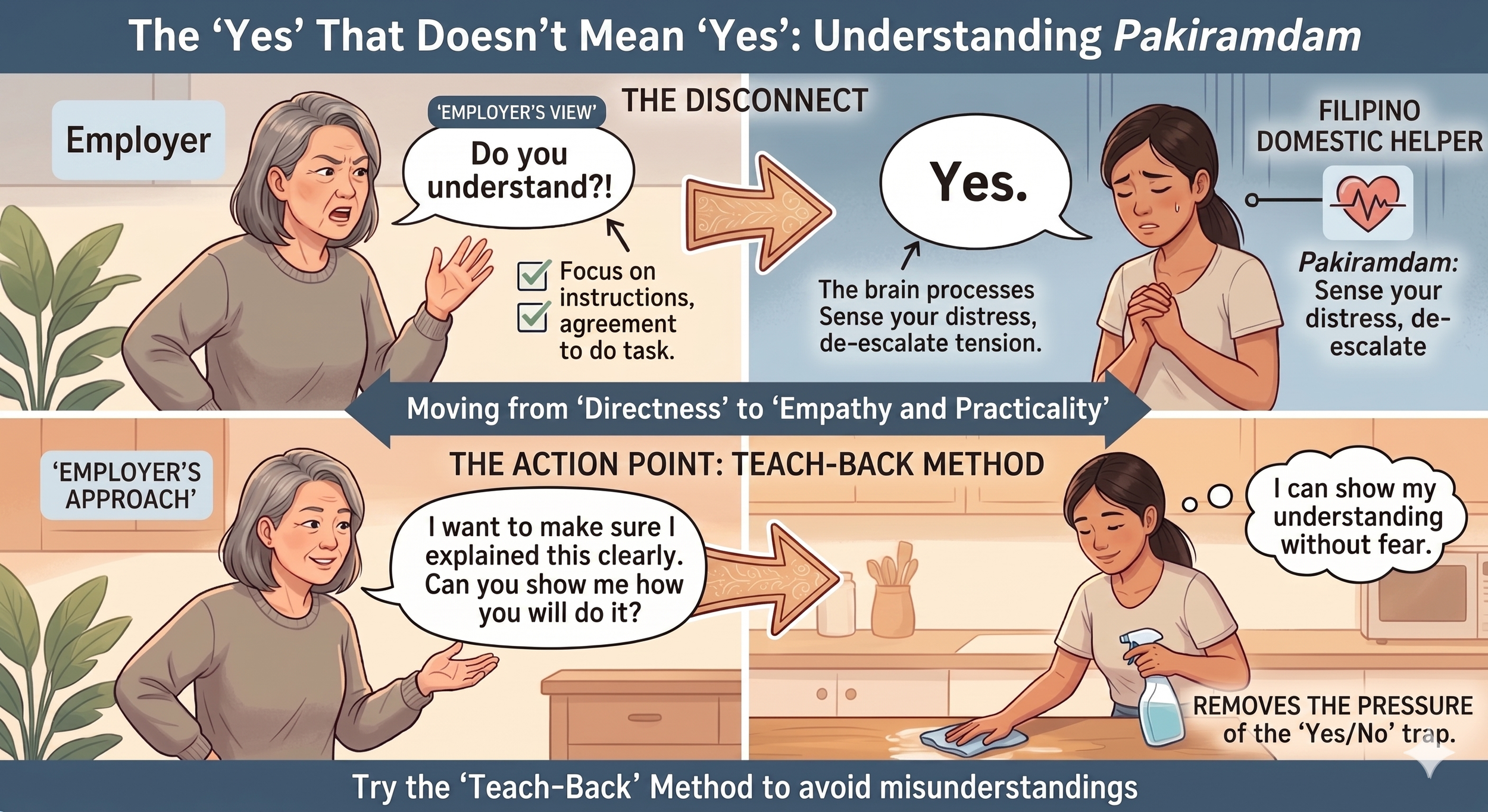
Understanding the Filipino concept of Pakiramdam (The Shared Feeling)
In Hong Kong, we value directness. We ask a question; we expect a "Yes" or "No." But for your Filipino helper, direct confrontation is a sign of a breakdown in the relationship. When you are angry and ask, "Do you understand?", and she says "Yes" (but then fails to do the task), she isn't lying to you. She is practicing Pakiramdam.
She is "feeling" your anger and her primary goal is to de-escalate the tension. Her "Yes" actually means: "I see you are upset, and I want to stop the conflict." Because she is so focused on your emotions, her brain actually stops processing your instructions.
Thought Question: Think of a time your helper said "Yes" but failed the task. Was your tone of voice urgent or angry at that moment?
Action Point: Try the "Teach-Back" Method. Instead of asking "Do you understand?", say: "I want to make sure I explained this clearly. Can you show me how you will do it?" This removes the pressure of the "Yes/No" trap.
Understanding the Filipino Family
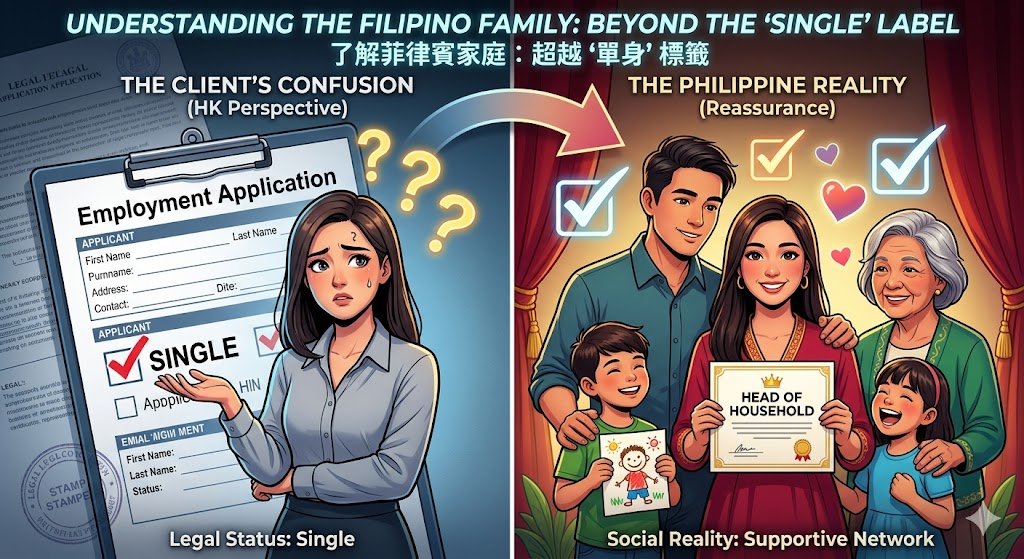
This blog post is designed to help Hong Kong employers navigate the unique social and legal landscape of the Philippines.
The "Single" Parent Paradox: Understanding Family in the Philippines
A Guide for Hong Kong Employers and Families
In Hong Kong, we value clarity. When we see "Single" on an application, we imagine someone with no ties. When we see "Married," we imagine a stable household. However, applying these same definitions to a Filipino candidate can lead to a significant misunderstanding of who they really are.
In the Philippines, "Single" is often a legal technicality, not a social reality. Because the Philippines does not have a divorce law, many people who have been in committed, 10-year "partnerships" with children must still write "Single" on their ID cards.
To help our Hong Kong clients find the most reliable and stable candidates, Arrow is moving beyond these confusing legal labels. We are introducing four new status categories that describe the actual responsibility a person carries at home.
The 4 New Family Status Categories
To provide more transparency for our customers, we now categorize our candidates based on their household dynamics rather than just their legal paperwork:
1. Married (Legal)
Who they are: These candidates have a formal marriage certificate recognized by the government.
What it means for you: This represents a traditional family structure. In many cases, the spouse remains in the Philippines to manage the household or works alongside the candidate to support the family.
2. Domestic Partnership
Who they are: These candidates live in a stable, long-term relationship with a partner (and often children) but are not legally married.
What it means for you: This is the most common "unseen" status. These candidates have the stability of a two-parent home. They have a partner at home to help with childcare and emergencies, making them highly reliable employees who aren't "alone" in their responsibilities.
3. Head of Household (Solo)
Who they are: This candidate is the primary leader and financial engine of their family. They may be widowed, separated, or a solo parent managing their children and often their elderly parents.
What it means for you: These are often the most motivated workers. Because an entire multi-generational family depends on their salary, they have an incredibly high "grit" and commitment to their job. They are the "CEOs" of their homes.
4. Single (Unattached)
Who they are: Candidates with no children, no live-in partner, and no previous legal ties.
What it means for you: These candidates typically offer the highest flexibility. They have fewer domestic distractions and can often adapt quickly to new schedules or travel requirements.
Why This Matters for Your Family
In Chinese culture, we often worry that a "Single Parent" might be distracted or lack support. But in the Philippines, the "Extended Family" is the safety net. Whether a candidate is in a Domestic Partnership or is a Head of Household, they are rarely "alone." They are supported by a network of aunts, grandparents, and siblings.
By using these new labels, we help you see past the "Single" checkbox and understand the true strength, stability, and motivation of the person you are bringing into your home.
Note to Employers: When you see "Domestic Partnership" on an Arrow profile, remember: This person has the commitment of a marriage, even if the law hasn't given them the piece of paper yet.
When Anger Is Costing You Money

1. The Hidden Price Tag On Your Temper
Many Hong Kong employers think of anger as a purely emotional problem: “I know I get angry, but that’s just my personality.”
What most people don’t realise is that frequent anger is also very expensive.
At Arrow, we regularly meet helpers who refuse to renew with an employer for one simple reason:
“My madam is always angry.”
When that happens, the employer doesn’t just “lose a helper.” They lose:
Agency fees for the next hire
Government fees and documentation costs
Two–three months of waiting for a new helper to arrive
Weeks of re‑training, mistakes, and adjustment
If you add this up across several contracts, an angry pattern can cost tens of thousands of dollars over a few years—plus a lot of stress for your family.
2. How Anger Destroys Contracts (Step By Step)
In more than 15 years of Arrow’s work with employers and helpers, we’ve seen the same pattern again and again.
Small mistakes happen
The helper is new, tired, or unsure. She forgets something or doesn’t do it “your way.”
Employer responds with sharp anger
Voice is raised, harsh words are used, mistakes are repeated again and again in the scolding.
Sometimes the anger has been building from other areas of life (“old anger”) and lands fully on the helper.
Helper becomes anxious and defensive
She starts to fear every mistake, so she hides problems or blames others.
She doesn’t feel safe to be honest with you.
Communication breaks down
Employer stops giving calm instructions, only speaks up when very upset.
Helper stops asking questions, because questions often lead to more scolding.
Resignation or termination happens
One day you hear the words: “Ma’am Sir, I want to resign.”
From our experience at Arrow: once a helper clearly says she wants to resign, she almost never changes her mind.
The expensive cycle repeats
Another hiring process, another adjustment period, another chance for the same anger pattern to play out.
The key point: anger doesn’t just hurt feelings; it directly pushes helpers towards resigning or not renewing, and each lost contract costs real money.
3. Rough Cost Of An Angry Resignation
Every case is different, but here is a rough picture of what one broken contract can cost a Hong Kong employer:
Agency fees + processing for a new helper
Hong Kong government fees and required documentation
Air ticket and related costs if you terminate or she finishes and leaves
At least 2 months with no full‑time helper at home while you wait for the new one
Time off work for interviews, immigration visits, medical checks
Extra spending on part‑time help or babysitting during the gap
And that’s just the money.
You also pay in:
Stress for you and your spouse
Instability for children, who may already be attached to the helper
Emotional strain on the helper’s side, which often feeds into her next job
If anger leads to two or three broken contracts over a few years, the total cost is significant.
Learning to manage your anger is not only about being “nice”; it’s a smart financial decision.
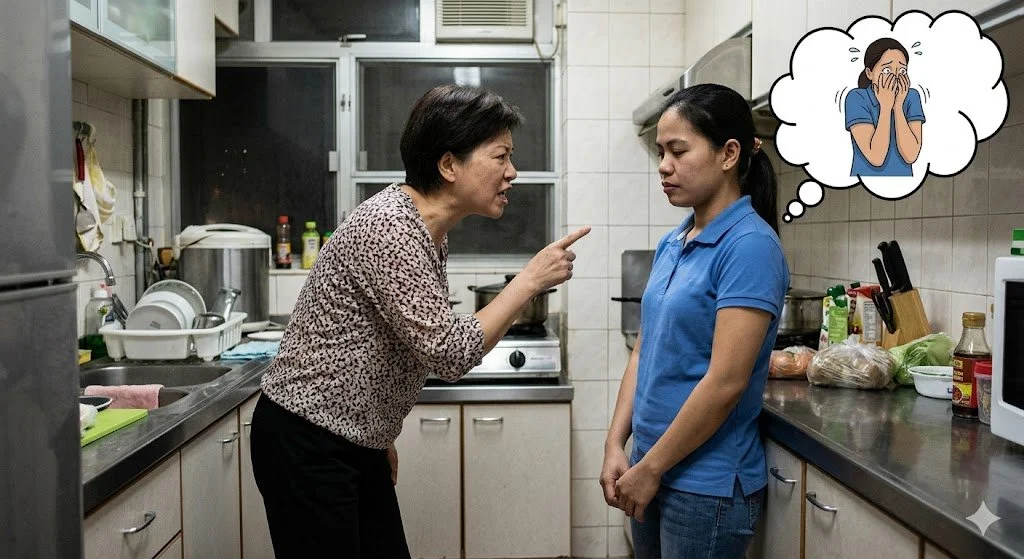
She may look calm on the outside, but on the inside helpers are often terrified. Terrified workers do not stay long.
4. “But Isn’t The Problem My Helper?”
You might be thinking:
“I’m angry because my helper is careless. If she just did her job properly, I wouldn’t lose my temper.”
We hear this a lot. But in many cases, when we listen to both sides, we discover that anger is not coming from today’s mistake only. It is often “old anger”—built up over years from stress, work, marriage, family, and past hurts.
Your helper may trigger your anger, but she is rarely the true source of it.
Also, many employers do not manage their helper like they would manage staff in a professional office:
No clear job description
Little or no training or handover
No regular performance reviews or encouragement
Mostly negative feedback, given when emotions are boiling over
If you treated your office staff like that, you would expect high turnover. It’s the same at home.
This is good news: if you change the way you manage and respond, you can dramatically improve the chances of keeping a good helper long‑term.
5. Signs Your Anger Might Be Costing You
Consider these questions:
Do you often raise your voice at your helper?
After a conflict, do you feel regret or think “I went too far”?
Has your helper ever said she is “scared” of you, or become very quiet and withdrawn?
Have you gone through several helpers in the last few years, with similar complaints each time?
If you answer “yes” to several of these, your anger is probably not just a “private issue.”
It is costing you money, peace, and stability.
6. Practical First Steps To Reduce The Cost Of Anger
You don’t need to become a “perfectly calm” person overnight. Start with small, realistic steps.
6.1 Pause Before You React
When you feel your anger rising:
Pause for 10–30 seconds.
Lower your voice on purpose.
If needed, say: “I am upset now. I will talk about this in a few minutes.”
This short pause can prevent the kind of explosion that leads helpers to think, “I need to leave this house.”
6.2 Correct Like A Professional Manager
Try to handle the situation more like a workplace:
Focus on one or two specific issues, not a long list of everything she ever did wrong.
Speak about behaviour, not identity.
“Please wash the dishes immediately after cooking,” instead of “You are so lazy.”
Explain what you want next time, not just what went wrong this time
6.3 Schedule Calm Conversations, Not Angry Ones
If there are ongoing issues:
Choose a calm time, not the middle of a busy morning.
Sit at the table, talk for 10–20 minutes about work, rest, and communication.
Avoid turning it into a “venting session.” Your goal is to solve problems and keep the contract, not to release all your frustration.
6.4 Use Your Agency Early—Not When It’s Too Late
From Arrow’s experience, by the time a helper clearly says, “I want to resign,” it is usually too late to repair the relationship.
Instead of waiting until the breaking point:
Call us earlier if you notice rising conflict, silence, or serious misunderstandings.
Let our customer care team listen to both sides and suggest practical steps.
Sometimes one or two guided conversations can save a contract and all the costs of starting again.
6.5 Consider Deeper Anger Help
If you notice that you are often angry—not just with your helper, but also with your spouse, children, or colleagues—this may be a sign of deeper, “old” anger that needs attention.
In Hong Kong there are:
Counselors and therapists
Anger management courses and workshops
Investing in this kind of help is not a sign of weakness; it is an investment in your family, finances, and future helpers.
7. The Real Question: What Do You Want Long‑Term?
Most employers tell us they want the same things:
A stable helper who stays several contracts
A peaceful home where children feel safe
A relationship built on trust and respect, not fear
If that is your goal, it is worth asking:
“Is my way of handling anger moving me towards this, or away from it?”
You cannot control everything your helper does.
But you can control how you respond—and your response is often the difference between a renewed contract and another expensive resignation.
Learning to manage anger is not just about being a “nice employer.”
It is about protecting your family’s finances, stability, and peace for many years to come.
Summary
Frequent anger doesn’t just hurt feelings; it pushes helpers to resign or not renew, which costs you money and stability.
Each broken contract means agency fees, government charges, months without a helper, and emotional stress for your whole family.
Often the problem is unmanaged, “old” anger and unprofessional management, not just the helper’s behaviour.
Simple changes—pausing before reacting, correcting professionally, using Arrow’s support early, and seeking deeper help if needed—can save both money and relationships.
The 5 million peso mistake

The ₱5 Million Mistake
The ₱5 Million Mistake: Is a Quick Loan Worth Your Future?
We all know the pressure. A family member gets sick, a roof needs fixing, or tuition fees are due. In Hong Kong, the temptation is everywhere—flyers in the street promising "easy cash" and "fast approval."
But there is a hidden price tag on those loans that the banks won't tell you about. It isn’t just the interest rate; it’s the cost of your future.
The Story of the $31,000 "Trap" Recently, a 32-year-old sister borrowed $31,000 HKD. Her employer found out, and she lost her job. Because of the way debt and records work now, it is highly likely she will never be able to work in Hong Kong again.
She might think she "won" because she kept the $31,000 and the bank can't find her in the Philippines. But let’s look at what she actually lost.
The Real Math If she is 32 now, she could have easily worked until she was 44. That is 12 years of potential work. At a salary of $5,100 HKD per month:
Yearly Income: $5,100 x 12 = $61,200 HKD
12 Years of Income: $61,200 x 12 = $734,400 HKD
In Philippine Pesos (at 7.6): ₱5,581,440
She traded ₱5.5 Million Pesos for a measly ₱235,000 ($31,000 HKD). She traded a lifestyle for a quick fix.
Why Employers Let People Go It’s about trust and safety. When debt collectors start calling the house, the employer feels their family is at risk. Once that trust is broken, your "Golden Ticket"—your HK work visa—is usually gone forever.
The Better Way: The $30,000 Goal Instead of paying a finance company interest, put that same money into an Emergency Fund.
The Goal: $30,000 HKD.
Why $30k? This covers almost any major emergency in the Philippines—medical bills, major house repairs, or a few months of family expenses.
When you save, you keep your power. If you have $30k in the bank and an emergency happens, you pay for it and you keep your job. Don't trade ₱5 million for a few thousand today.
Ang ₱5 Milyong Pagkakamali: Sulit ba ang "Quick Loan" sa Iyong Kinabukasan?
Alam nating lahat ang bigat ng obligasyon sa pamilya. Pero may nakatagong presyo ang mga loan na ito na hindi sasabihin sa iyo ng mga lending company. Hindi lang ito tungkol sa interes; ang kinabukasan mo mismo ang nakataya.
Ang Kwento ng $31,000 na "Trap" Kamakailan, may isang kabayan na 32 years old na nangutang ng $31,000 HKD. Nalaman ng amo, at agad siyang tinerminate. Malabo na siyang makabalik pa sa Hong Kong kailanman. Siguro iniisip niya na "panalo" siya dahil hawak niya ang pera, pero tingnan natin ang tunay na nawala sa kanya.
Ang Tunay na Kwenta (The Real Math) Kung siya ay 32 years old ngayon, kaya pa niyang magtrabaho hanggang edad 44 (12 taon pa). Sa sahod na $5,100 HKD kada buwan:
Sahod sa loob ng 12 taon: $734,400 HKD
Sa Philippine Peso (sa rate na 7.6): ₱5,581,440
Ipinagpalit niya ang higit ₱5.5 Milyon para sa kakarampot na ₱235,000 ($31,000 HKD). Ipinagpalit niya ang pangmatagalang ginhawa para sa panandaliang solusyon.
Bakit ba Nagteterminate ang mga Amo? Usapin ito ng tiwala at seguridad. Kapag nagsimulang tumawag ang mga debt collector sa bahay, natatakot ang mga amo para sa kaligtasan ng pamilya nila. Kapag nasira ang tiwala, ang iyong "Golden Ticket"—ang iyong HK work visa—ay nawawala nang tuluyan.
Ang Mas Matalinong Paraan: Ang $30,000 Goal Sa halip na magbayad ng malaking interes sa iba, simulan mong buuin ang sarili mong Emergency Fund.
Ang Goal: $30,000 HKD.
Bakit $30,000? Sapat na ito para sa hospital bills, major house repairs, o panggastos ng pamilya habang naghahanap ng solusyon.
Kapag may ipon ka, ikaw ang may kontrol. Kung may $30k ka sa banko at may emergency, mababayaran mo ito at mananatili ang trabaho mo. Huwag ipagpalit ang ₱5 Million para sa kakarampot na halaga ngayon. Piliin mong mag-ipon.
How To Do a Great First Week Handover With Your New Helper

Introduction: Why the First Week Matters
The first seven days with a new domestic helper quietly set the tone for the whole contract. Many Hong Kong employers are extremely busy, so the first week becomes a rush of documents, bank accounts, and “figure it out as you go.” The result is predictable: your helper guesses what you want, makes avoidable mistakes, and both of you start feeling disappointed.
But a good handover does not require a lot of extra time. It requires structure. If you treat the first week as “training week” instead of “test week,” you give your helper a fair chance to understand your home, your standards, and your family’s rhythm. That investment can save you months of frustration later.
This post offers a simple, realistic plan for the first week, especially for busy Hong Kong families. Adapt it to your home and your helper’s experience level. The goal is not a perfect house in seven days; the goal is a shared understanding that will grow over the next two years.
Before Day 1: Prepare, Don’t Improvise
Before your helper even walks into your home, take 30–60 minutes to prepare.
Write a basic daily schedule
Example: wake‑up time, breakfast, school runs, main cleaning block, cooking time, evening routine.
Keep it simple and flexible; it’s a starting point, not a prison.
List your non‑negotiables
These are the most important rules and standards (children’s safety, privacy, valuables, phone use during work, hygiene).
If everything is “top priority,” nothing is. Choose 5–7 key points.
Decide where things will live
Cleaning supplies, cloths, bins, recycling, laundry baskets, children’s toys.
If your helper spends the first week just hunting for things, she can’t focus on quality.
Prepare a simple “house book” (optional but powerful)
A cheap notebook with: routines, key phone numbers, addresses, Wi‑Fi password, reminders.
This becomes your shared reference so you repeat less and she forgets less.
Day 1: Welcome, Not Inspection
Day 1 is about relational safety and basic orientation, not about testing.
Start with a warm welcome
Introduce family members by name and what they like to be called.
Show her her room and bathroom, where to put her things, and where she can keep personal items safely.
Share the big picture of your family
Who works where, school schedules, elderly or special needs in the home, pets.
Briefly explain your expectations in one sentence: for example, “We value honesty, cleanliness, and kindness with our children.”
Explain non‑negotiable rules calmly
Phone use during working hours, visitors, food rules, security (doors, gas, keys).
Ask her to repeat key points in her own words to check understanding.
Keep Day 1 work light
Give simple, shorter tasks: unpacking, basic tidying, maybe a light meal.
She is tired, nervous, and overloaded. A “perfect” first day is not realistic.
Days 2–3: Demonstrate and Do Together
These days are for “show and do,” not “tell and disappear.”
Start with one area at a time
Example focus for Day 2: kitchen and dishes. Day 3: bathrooms and laundry.
Demonstrate once slowly, then let her do it while you watch.
Use clear, specific language
Instead of “clean properly,” say, “Please scrub this area until there is no grease, and then wipe it dry.”
Show what “finished” looks like: open cupboards, under sink, behind stove.
Invite questions on purpose
Ask: “What is unclear? What would you like me to repeat?”
Many helpers are shy to ask, especially in the first days. You must open the door.
Give immediate, gentle feedback
Correct small things right after the task: “This is good. Next time, please also wipe this corner.”
Always combine correction with at least one sincere encouragement.
Days 4–5: Build the Routine and Standards
Now you slowly move towards a more normal schedule.
Introduce a simple daily plan
For example:
Morning: breakfast, school run, tidy bedrooms, laundry.
Afternoon: main cleaning area of the day (kitchen Monday, bathrooms Tuesday, etc.).
Late afternoon: dinner prep, kitchen clean‑up.
Write it down and place it where she can see it.
Teach your standards, room by room
Walk through each area after she finishes cleaning and show details that matter to you.
Use phrases like: “For me, clean means…” and show specific spots she may miss.
Clarify cooking expectations
Discuss how often she will cook, dietary restrictions, spice levels, oil and salt preferences.
Start with simple dishes; consider letting her cook a Filipino dish on one day so you can see her style.
Keep communication daily
Take 5–10 minutes each evening to ask: “How was today? What is difficult? Any questions?”
This small habit can prevent misunderstandings from growing.
Days 6–7: Review, Adjust, and Encourage
By the end of the first week, both of you know more about each other.
Review the first week together
Ask: “What do you feel confident about? What is still confusing?”
Share the same from your side, calmly and clearly.
Adjust the routine where needed
If something in your plan is unrealistic, change it now instead of silently expecting the impossible.
Make sure she knows which tasks are “daily” and which are “weekly.”
Reinforce your priorities
Repeat your main values: honesty, children’s safety, respect for privacy, etc.
Make clear that you prefer she tells you bad news early rather than hide problems.
End the week with encouragement
Thank her for her effort in a new place and culture.
Mention specific things she has done well: “I appreciate how you care for the children,” or “The bathroom is much cleaner since you started.”
Common Mistakes Employers Make in the First Week
Even good employers fall into these traps:
Expecting “automatic” understanding
Assuming previous experience means she knows your way without teaching.
Correcting only when angry
Waiting until you are frustrated, then exploding about several days’ mistakes at once.
Overloading with too many rules
Giving a long list of 30 rules on Day 1 that nobody can remember.
Giving up too quickly
Deciding “she’s no good” within the first few days instead of coaching.
Avoiding these patterns will make your handover far more effective.
A Simple First Week Checklist
You can adapt this quick checklist for your fridge or house book:
Gave helper house tour and introduced family
Explained non‑negotiable rules
Walked through kitchen routines
Walked through bathroom and laundry routines
Explained basic daily schedule
Did at least one daily 5–10 minute check‑in
Reviewed week and agreed adjustments
If you can tick most of these by the end of Week 1, you are already ahead of many households.
Starting well does not guarantee a perfect contract. But a clear, kind first week gives your helper a fair chance to succeed and gives you a much stronger foundation to correct, guide, and build trust over time. A little planning now can save you many difficult conversations later.
Is your helper ready for an emergency?
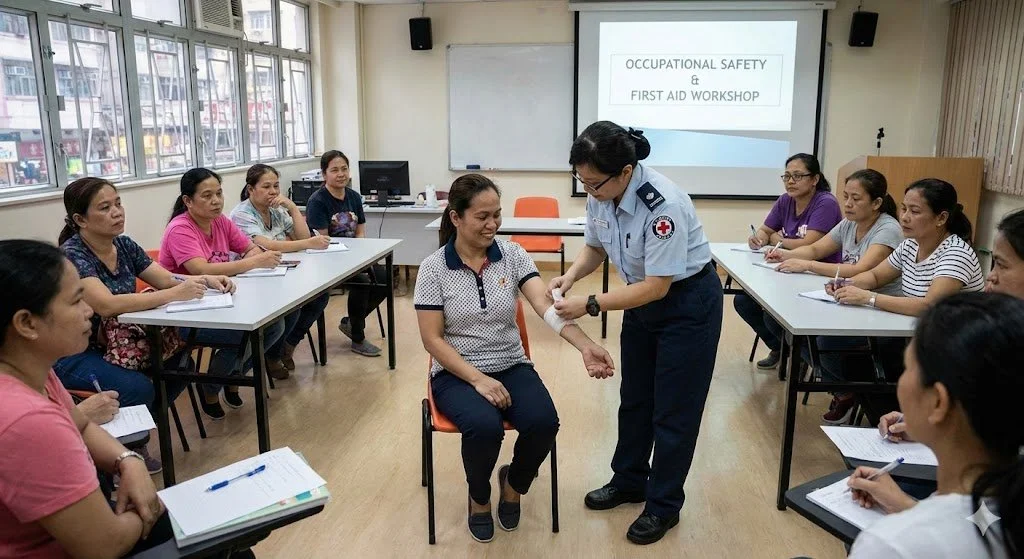
Employers often feel helpers lack "common sense," but common sense is local and cultural. What is obvious in a rural village is not obvious in a Hong Kong high-rise. Assuming your helper will know what to do in an emergency is a mistake; relying on training saves lives.
Domestic workers are often alone with children or the elderly. In a fire, they must manage panic, smoke, and confusion instantly. Here is how you can move them from "improvising" to "prepared."
1. Walk the Escape Route Don't just talk about it. Physically walk the escape route together. Show her exactly which stairwells to use and where the refuge floors are. Do this when the building is calm so she can build a mental map.
2. Create a "Decision Tree" Clarify the rules: When should she run? When should she stay and seal the door? Verbal instructions are forgotten under stress, so write down a simple Emergency Plan (in English and her native language) covering fire, injuries, and 999 protocols.
3. Review Home Safety Basics
Kitchen: Oil fires (never use water to try and put out an oil fire!), gas safety, and never leaving the stove unattended.
Electrical: No overloaded sockets or damaged cords.
Windows: Strictly follow regulations—locked grilles and no leaning out.
4. Practice & Support Run "mini-drills" occasionally (e.g., "What if the alarm goes off now?"). If a scare happens, debrief calmly without accusation. Emotional support turns fear into confidence.
Please share your own safety tips with us so we can pass them on to the Arrow community.
MaryAn Pascual Esteban

Last month’s fire at Wang Fuk Court in Tai Po broke many hearts, including ours. Among the lives lost was MaryAn Pascual Esteban, an Arrow helper who died alongside the five‑year‑old girl she had cared for since birth.
MaryAn had served faithfully for years and was preparing to return home permanently to her own son in the Philippines. Instead, her family is now grieving a mother described as kind and uncomplaining.
This tragedy reminds us that domestic workers are more than "helpers"; they are caregivers and often first responders. In emergencies, they are the ones making split-second decisions to protect our children and elderly parents. MaryAn was an "ordinary hero" who did her best in terrifying conditions.
How can we respond as a community?
Grieve: With MaryAn’s family, her employers, and the neighbors rebuilding their lives.
Appreciate: Affirm the dignity of your helper. Let her know you value the sacrifice she makes to serve your family.
Prioritize Safety: Ensure your home and instructions actually equip your helper to act wisely in an emergency. Don't leave them to just “figure it out.”
At Arrow, we are reviewing our safety training and resources to better support you. If this tragedy has raised concerns about safety in your own home, please reach out to us. We are here to walk with you.
With sadness and respect,
Allan Smith
Arrow Employment Services
Navigating 'Hiya': Why Saving Face Is a Big Deal in Filipino Culture

Have you ever asked your helper if she understands a task, only to get a quick "yes," but then find it wasn't done correctly? It can be frustrating, right? You might think, "Why didn't she just tell me she didn't know how?"
The answer might be a core part of Filipino culture called "hiya" (pronounced hee-yah). While often translated as "shame" or "embarrassment," it's more about "saving face" for oneself and for others. Understanding hiya is key to avoiding misunderstandings and building a stronger relationship with your helper.
What Is "Hiya" and How Does It Affect the Workplace?
Hiya is a deep-seated cultural value that governs social interactions. In a professional context, it can make someone hesitant to do anything that might cause a negative reaction.
Here's how hiya can show up in your household:
Hesitation to Ask Questions: A helper might worry that asking for clarification suggests they are incompetent, so they'll say "yes" even if they don't fully understand.
Avoiding "No": Saying "no" to a request from an employer can be seen as disrespectful or confrontational, so a helper may agree to a task they can't complete.
Taking Correction Personally: Direct, public criticism can feel like a major loss of face, causing deep embarrassment and potentially damaging trust.
When you understand this, you can see that a helper who seems to avoid direct communication isn't trying to be difficult—she's simply navigating a deeply ingrained cultural norm.
Practical Tips for Giving Feedback Effectively
Now that you understand the "why," here's how to communicate in a way that respects hiya and gets the results you want:
1. Keep Feedback Private.
Never correct or criticize your helper in front of your children, other family members, or guests. A private conversation in a calm tone is far more effective. Publicly calling out a mistake is a major source of hiya and can erode the professional respect you've worked to build.
2. Use the "Sandwich Method."
This classic feedback technique is incredibly effective when dealing with hiya.
Start with something positive: "The house looks so tidy, thank you for all your hard work."
Offer the constructive feedback: "I just wanted to show you a slightly different way to clean the windows—this method helps avoid streaks."
End with another positive statement: "You're a great help, and I really appreciate you taking the time to learn."
3. Focus on the Task, Not the Person.
Instead of saying, "You did this wrong," try to rephrase your feedback to focus on the action. For example, "Let's try to do it this way to make the task faster," or "I prefer the plates to be stacked like this." This avoids putting the helper on the defensive and makes it easier for her to accept the new instruction.
By being mindful of hiya, you're not just being a good boss; you're showing cultural intelligence and respect. These small shifts in your communication style can lead to a more positive and productive relationship, helping you find and keep a great helper for years to come.
I would love to hear your feedback. Leave a comment.
Give us this day our daily RICE!
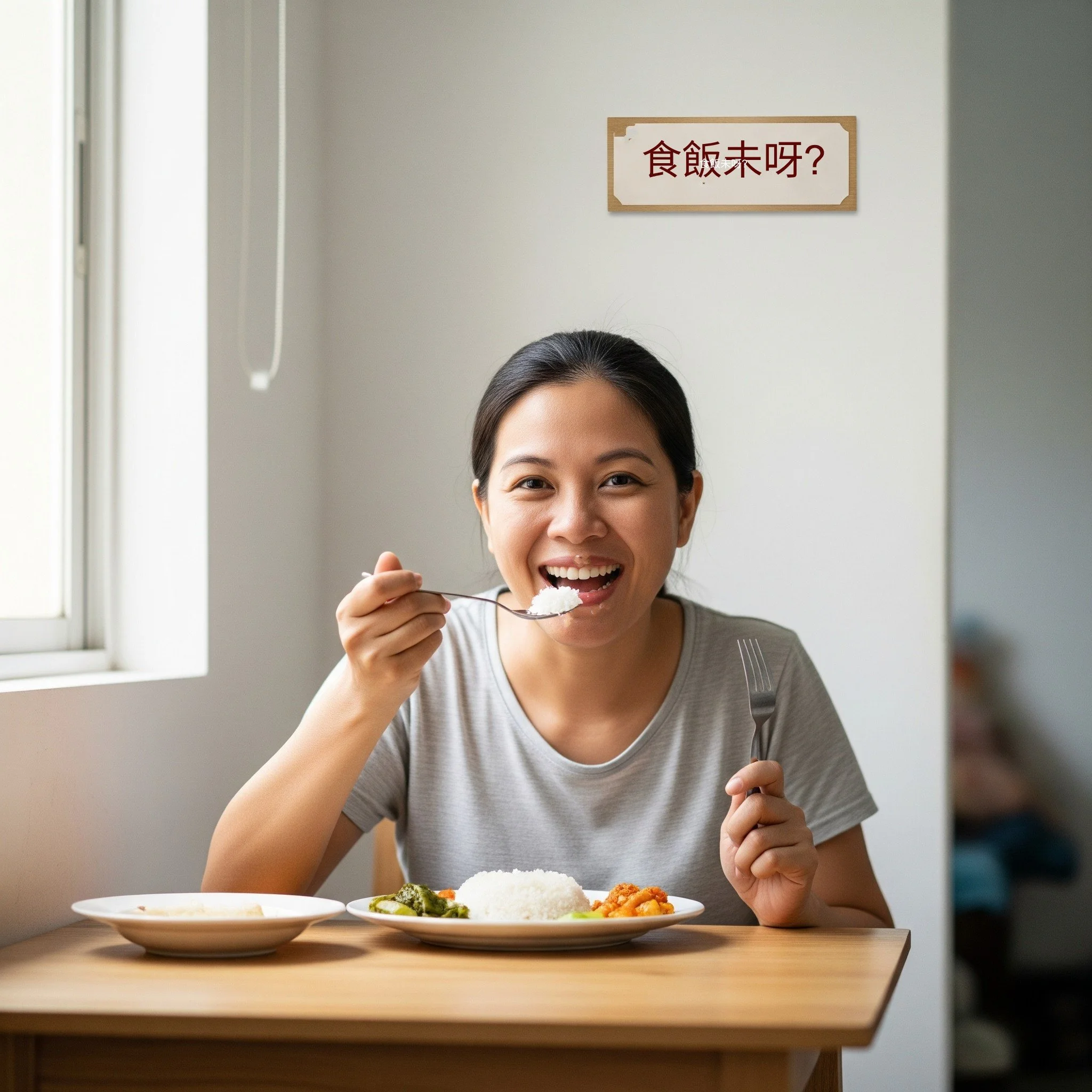
食飯未呀?
The Importance of Rice to Filipinos: A Guide for Hong Kong Employers
“I FEEL HUNGRY” - Food is a common flash point between HK employers and their helpers. If you don’t want to read the rest of the article, here is the simple solution. Buy her a rice cooker and a bag of rice every month. Problem solved. You can stop reading.
Rice is far more than just a staple food in the Philippines—it is woven into the fabric of daily life, tradition, and family for millions of Filipino people. For Hong Kong employers, especially those of Chinese background who employ Filipino workers, this should not be difficult to understand. One of the first greetings I learned when studying Chinese was: “Sihk faahn meih?” 食飯未呀? In modern HK with our busy lifestyles, rice is not as important to our diet as it used to be. BUT for Filipinos it is VERY Important, just as important as it was to a Chinese living 100 years ago. Understanding the role and meaning of rice can help foster harmonious relationships and minimize misunderstandings at home.
Why Is Rice So Important to Filipinos?
Cultural Staple: Rice is the centerpiece of Filipino cuisine. For most Filipinos, a meal is not truly a “real meal” without rice—even if the main dish features meat or vegetables, rice must be present.
Daily Sustenance: Many Filipinos eat rice for breakfast, lunch, dinner, and even snacks. It is filling, affordable, and can be paired with almost anything—meat, fish, vegetables, or even simple condiments during tough times. They often don’t feel full without rice.
Symbolic Value: Rice is deeply tied to Filipino identity. It brings families together at mealtimes and is also present in important life rituals, festivals, and celebrations. Offering rice is seen as an act of hospitality and respect. Withholding rice is seen as an uncaring act.
Economic Importance: For lower-income families in the Philippines, rice may be the only food available. It fills the belly and keeps hunger at bay—a necessity for many who work hard and send money home.
Adaptability: Aside from steamed rice, Filipinos enjoy rice in many forms: porridge (“lugaw” or “champorado”), special cakes (“biko,” “suman”), and as accompaniments to savory dishes.
Common Food Conflicts in Hong Kong Homes
Food is a common topic of confusion and disagreement between Hong Kong employers and Filipino helpers. Here’s why:
Meal Frequency: Hong Kong families often eat three meals a day, while many Filipinos are used to eating five to seven times daily, including snacks and afternoon tea.
Taste Preferences: Filipino helpers may find local foods unfamiliar, plain, or lacking. Sometimes, helpers receive food that isn’t fresh or nutritious, while employers think it is sufficient.
Food Allowance vs. Provided Food: When the contract stipulates ‘food provided,’ both parties may have different expectations. Employers may believe offering three meals is enough; helpers may expect snacks, extra rice, or the flexibility to choose familiar foods.
Reluctance to Speak Up: Filipino helpers are often shy to voice their needs or express hunger, fearing it may upset their employer or seem disrespectful. At the same time however, they will feel SHAME if you don’t give them enough food. They think “I work so hard all day, and my employer doesn’t even give me enough food to eat!”
Simple Solutions to Resolve Food and Food Allowance Conflicts
Open Communication
Discuss food preferences and arrangements openly during the interview. Ask your helper what foods she likes and explain household food routines.
Make expectations clear about what foods are available, how meals and snacks are handled, and what is off-limits without permission.
Respect Dietary Choices
If providing food, respect your helper’s need for rice. Consider stocking extra rice and a few familiar Filipino ingredients. This small gesture can make helpers feel welcomed and cared for.
If you are unable to cater to her food preferences, explain the limits kindly and consider alternatives.
Consider the Food Allowance
Understand the current government standards: As of September 2024, the food allowance for helpers in Hong Kong is HK$1,236/month.
If giving food allowance instead of meals, provide it at the start of the month. Let your helper have the freedom (and responsibility) to buy her own food, which often helps avoid conflicts over food choices.
Another alternative is simply to set aside part of the household food budget for her use. If you are a family of 4 (mom, dad & 2 kids) and have a food budget of $2000/month, then consider setting aside $400/month for her to buy some items that she would enjoy.
Provide Snacks and Flexible Meal Times
Keep simple snacks (bread, fruit, crackers, rice) available for your helper to eat when hungry. 3 in 1 coffees with a pastry is a common afternoon snack in the Philippines.
Allow helpers to eat when they feel hungry, within reasonable boundaries.
Documentation and Clarity
If you pay a food allowance, keep a signed monthly record for clarity and accountability.
Make sure the helper knows she can ask questions or voice concerns about food without fear.
Final Thoughts
Rice is not just food to Filipinos—it’s comfort, tradition, and a source of strength. By understanding and respecting your helper’s relationship to rice and food, you can nurture a happier, more productive home environment. Open conversations and mutual respect are key to preventing and resolving any food-related misunderstandings.
A little extra rice in the pot can go a long way to building trust—and happier helpers—in your household.
Let me know what you think. Leave a comment.
OFW savings a Hero’s story
The above video was created by AI from real case studies and surveys of OFWs and their struggles saving $$. Leave a comment please!!
Avoiding Debt traps and scams for OFWs and their employers
I did some research and using AI I created an audio podcast talking about how to recognize and avoid debt traps, and what to do if you’ve been caught up in one. You will want to LISTEN to this!
Google's AI gives advice on managing a Filipino worker.

I asked Gemini to assume the persons of a Filipino management expert, and give advice to HK Chinese employers re how to best manage their Filipino workers. Here's what it came back with:
Here's how you can best manage your Filipino domestic helper:
1. Foster a Foundation of Respect and Understanding:
* Acknowledge Her Professionalism: Your domestic helper is a professional providing a service. Treat her with the same respect you would any other employee. Avoid derogatory terms or treating her as "just a helper."
* Understand Her Background: Most Filipino FDHs come from strong family-oriented cultures. They often leave their own families behind to support them financially. This sacrifice is significant and understanding it can foster empathy. Many also have a good level of education, even if their current role doesn't fully utilize it.
* Cultural Sensitivity: Filipinos are generally polite, non-confrontational, and value "hiya" (shame/loss of face). Direct criticism, especially in front of others, can be deeply embarrassing. If you need to correct her, do so privately and constructively.
* Language: While many Filipinos speak English, Tagalog (Filipino) is their national language. Learning a few basic Tagalog phrases can go a long way in building rapport. Ensure she understands instructions clearly; don't assume.
2. Clear Communication is Paramount:
* Define Expectations Clearly from the Start: Before she even begins, or as soon as possible, clearly outline her duties, responsibilities, working hours, rest days, and any specific household rules. Write them down if necessary. Avoid ambiguity.
* Regular Check-ins: Schedule brief, regular meetings (e.g., weekly) to discuss progress, address any issues, and provide feedback. This creates a safe space for her to voice concerns as well.
* Constructive Feedback: When giving feedback, focus on the task or behavior, not on her personality. Be specific, provide examples, and suggest ways for improvement. Always end on a positive note or express confidence in her ability to improve.
* Listen Actively: Encourage her to ask questions and express her needs or difficulties. Sometimes, what seems like defiance is simply a misunderstanding or a struggle she's facing.
* Avoid Assumptions: Don't assume she knows how you like things done, even if she has previous experience. Every household is different. Demonstrate rather than just tell.
3. Fair Treatment and Adherence to Labor Laws:
* Comply with Hong Kong Labor Laws: This is non-negotiable. Adhere strictly to regulations regarding minimum wage, rest days, statutory holidays, food and accommodation allowances, and severance pay if applicable. This protects both you and her.
* Adequate Rest Days: Ensure she gets her mandated weekly rest day. This is crucial for her physical and mental well-being and helps prevent burnout. Respect her time off and do not ask her to perform duties on her rest day.
* Respect Private Time and Space: While she lives in your home, she also needs her own personal space and privacy, even if it's a small room. Avoid unnecessary intrusion into her personal affairs.
* Food and Accommodation: Provide adequate and nutritious food. If she prefers to cook her own food, ensure she has access to suitable provisions or a food allowance. Her living quarters should be clean, safe, and comfortable.
* Medical Care: As her employer, you are responsible for providing medical attention if she falls ill or is injured during her employment.
4. Empower and Support Her Growth:
* Training and Development: If there are specific tasks she struggles with, offer to train her or provide resources. Investing in her skills benefits your household in the long run.
* Trust and Autonomy (within limits): Once she's proven her capability, give her a reasonable degree of autonomy in managing her tasks. Micromanagement can be demotivating.
* Acknowledge and Appreciate: A simple "thank you," a word of praise, or acknowledging a job well done can significantly boost morale. Filipinos respond well to positive reinforcement.
* Support Her Well-being: Understand that she may experience homesickness or stress. Be approachable if she needs to talk. While you are her employer, a degree of empathy goes a long way. Support her in connecting with her family if possible (e.g., allowing use of internet for video calls during her free time).
5. Handling Challenges and Conflict:
* Address Issues Promptly and Privately: Don't let small issues fester. Address them as soon as they arise, but always in a private setting.
* Stay Calm and Rational: Even if you're frustrated, maintain a calm and respectful demeanor. Yelling or emotional outbursts are counterproductive and can damage the relationship permanently.
* Seek Mediation if Necessary: If serious conflicts arise that you cannot resolve yourselves, consider seeking advice from relevant agencies like the Labour Department or organizations that support FDHs.
By implementing these strategies, you can cultivate a respectful and efficient working relationship with your Filipino domestic helper, leading to a more harmonious household and a mutually beneficial experience for both parties. Remember, a well-managed and respected helper is a happy and productive helper.
好奇心是你的朋友

我們來聊聊好奇心——這個真正能扭轉局面的關鍵。
您可能聽過「好奇心害死貓」這句話。但說實話,這對好奇心有點不公平!事實上,正是好奇心為我們帶來了輪子、電力、紙張、互聯網、量子科學,甚至是人工智能。(是的,我用了我最喜歡的人工智能來幫助我編輯這封郵件)。當然,好奇心有時可能會帶來風險,但這些風險是值得的——因為自以為無所不知,會帶來更大的限制,甚至是有害的。
為什麼好奇心對我如此重要
我在香港生活了超過三十年。我是否真正了解香港,以及香港人的所思所感?也許比初來乍到的遊客多懂一點點,但事實是,關於香港人和中華文化,我還有很多需要學習的地方。是什麼幫助我成長?是好奇心。
我也與菲律賓籍的家庭傭工緊密合作超過十五年,並且每年都有一段不短的時間待在菲律賓。此刻,我正在馬尼拉外的甲米地省(Cavite)寫這封信。我完全了解菲律賓人嗎?可能比許多人了解得更深,但仍未完全通透。正是好奇心幫助我與人連結、學習,並作出更周詳體貼的回應。
一個值得深思的想法
今天早上我讀到一句話:
「一個人有多大機會,能準確地解讀自己一生中所有的日子?」
在我的成長過程中,我曾面臨許多挑戰,並對我的家人和他人作出了許多論斷——總以為自己知道他們的動機和感受。十幾歲的時候,我把很多問題都歸咎於我的父親。但如果我錯了呢?如果我誤解了他的言行呢?這是非常有可能的。然而,那些解讀卻影響了我多年的決定。
好奇心促使我以全新的眼光和開放的心胸,重新審視那些回憶,幫助我更深入地理解和成長。
這對您為何重要?
如果您僱用了一位菲律賓籍的家庭傭工,您的家中就有了一位來自與您截然不同的文化和背景的人。對您和您的家傭來說,彼此感覺就像是降落在一個由陌生外星人佔據的星球上一樣,這是很自然的。那麼,您該如何建立更深的理解和更穩固的工作關係呢?
這裡有一些簡單的提示:
提問並聆聽:* 對她們的想法和感受表現出真誠的興趣。把自己想像成一位社會科學家,想要去了解這個來自「外星」的人。
假設她們的行為合乎其理:* 她們的行為源於她們的經歷和文化,對她們來說是合乎情理的。客戶常常對我說:「我的家傭缺乏常識」。這是因為所謂的「常識」並非普世通用(NOT COMMON),而是植根於當地文化(IT's LOCAL)。她不知道如何像本地人一樣行事,因為她不是本地人。如果您移居到她的國家,您同樣會缺乏「當地常識」。
放下成見:* 保持好奇,而不是輕率地作出結論。不要輕易給她們貼上標籤(例如:騙子、不誠實、懶惰等),而是嘗試理解她們的行為對她們來說為何是合理的,並向她們解釋您希望事情如何完成,以及為什麼這在我們的環境中很重要。
專注於行為和解決方案:* 問她:「你需要什麼才能把工作做好?」如果您的家傭表現下滑,請坐下來和她談談:「我注意到妳最近似乎心煩意亂、很疲憊,或者看起來很傷心/擔憂等等。」有些事情正影響著妳的工作,你需要什麼幫助才能重回正軌?
提供支援:* 在資源或指引上幫助她們。您也可以向Arrow尋求建議。我們很樂意就如何處理情況向您提供建議,但您要求我們直接與您的家傭交談,幾乎都不是一個好主意。
跟進並讓她為自己的承諾負責:* 親切而清晰地檢查進度。設定一個時間進行後續交談,看看你們雙方同意的解決方案是否得到了執行。
好奇心不僅僅是一種特質——它更是一種建立信任、理解和尊重的強大工具。它可以將您與家傭的關係,轉化為對雙方都有益和具回報的正面關係。
感謝您花時間閱讀。希望這封郵件能激發您在日常生活中擁抱好奇心!
Allan 謹啟
Measles is bad news!

Image created by Qwen.ai
The Hong Kong government is urging employers to ensure that their helpers received the MMR vaccination before they arrive in HK. If your helper has not been immunized, you should arrange for her to get the vaccine ASAP. We did a little homework and found these locations where you can get vaccinated:
Hong Kong Hearts Vaccination Centre (Yau Ma Tei)
This specialized vaccination center offers great service and is wheelchair accessible. It’s a convenient option if you want a focused vaccination experience with friendly staff.Location: Yau Cheung Rd, Yau Ma Tei
Phone: +852 3589 6758
Hong Kong Baptist Hospital (Kowloon Tong)
A reputable private hospital with good service and caring medical staff. They provide a wide range of vaccinations including MMR.Location: 222 Waterloo Rd, Kowloon Tong
Phone: +852 2339 8888
Hong Kong Adventist Hospital (Happy Valley)
Known for quality healthcare, this private hospital is another excellent place to get vaccinated, with a comfortable environment and professional care.Location: 40 Stubbs Rd, Happy Valley
Phone: +852 3651 8888
Hong Kong Families Clinic (Morrison Hill)
A medical clinic that offers vaccinations and recommends making an appointment. It’s a good choice if you prefer a smaller clinic setting.Location: 18 Oi Kwan Rd, Morrison Hill
Phone: +852 2574 1683
Shoebill Health Care Vaccination and Health Management Centre (Wan Chai)
This center specializes in vaccines and health management, with excellent ratings and appointment-based service. Perfect if you want a dedicated vaccination center with personalized care.Location: 113-117 Wan Chai Rd, Wan Chai
Phone: +852 5688 3408
Public General Outpatient Clinics (e.g., Tang Shiu Kin Hospital Violet Peel Clinic, Sai Ying Pun Jockey Club Clinic)
If you prefer public healthcare, these clinics provide vaccinations including MMR, usually by appointment. They are accessible and have solid reputations.Tang Shiu Kin Hospital Violet Peel Clinic: +852 3553 3116
Sai Ying Pun Jockey Club Clinic: +852 2859 8203
Tips:
It’s best to call ahead to confirm availability and whether you need an appointment.
Some centers may require you to bring your vaccination records or ID.
If you have specific health concerns, private hospitals and specialized vaccination centers can offer more personalized consultations.
With these options, you can easily find a convenient and reliable place in Hong Kong to get your MMR vaccine and keep yourself and your loved ones protected.
Answer from Perplexity: pplx.ai/share
Prepare Your Helper for a Smooth & Auspicious Chinese New Year! 🧧

Chinese New Year is fast approaching, and we know this means a busy time for your household! To ensure a smooth and joyous celebration for everyone, we've put together some helpful tips to prepare your domestic helper for the festivities, while avoiding any cultural faux pas:
Explain the Significance: Share the meaning behind CNY traditions like lion dances, red envelopes, and family reunions. This helps your helper understand the cultural context and appreciate the importance of their role during this period.
Food Preparation: Discuss your CNY menu in advance. Filipino cuisine differs greatly from Chinese, so providing clear instructions and recipes for traditional dishes is essential. Consider a trial run beforehand to ensure everyone is comfortable with the preparations.
Guest Etiquette: Inform your helper about expected guest etiquette, such as greeting guests with "Kung Hei Fat Choi," offering tea and snacks, and assisting with serving. Explain any specific seating arrangements or cultural sensitivities related to serving elders.
Gift Giving: Explain the tradition of "lai see" and clarify who should receive red envelopes. Advise your helper on appropriate attire for visiting relatives or attending New Year gatherings.
Time Off and Expectations: Communicate clearly about your helper's schedule during the holidays, including any expected days off or adjusted working hours. Openly discuss any additional duties, like childcare or assisting with guests, and ensure fair compensation for extra work.
New Year's in the Philippines

Fireworks in Culion, Philippines
New Year's Day, or Araw ng Bagong Taon, is super important to Filipinos. Their New Year traditions and cultural practices reflect their hopes for prosperity and good fortune in the coming year. (Sound familiar?) The celebration is deeply rooted in a blend of local customs and influences from Spanish and Chinese cultures.
New Year's Day is not just a holiday; it symbolizes a fresh start and renewal. Filipinos engage in various traditions to welcome the new year with optimism:
Media Noche: At midnight Filipino families gather together to share a lavish feast that includes traditional dishes such as lechon (roast pig) and pancit (noodles), which symbolize abundance, prosperity and good health for the year ahead.
Fireworks and Noise: The night leading into New Year's Day is characterized by loud celebrations, including fireworks and firecrackers. The noise is believed to scare away evil spirits, ensuring smooth sailing for the year ahead.
Unique Traditions:
Filipinos have some unique traditions associated with the New Year celebrations, including:
Wearing Polka Dots: Many Filipinos wear clothing with polka dots, as round shapes are thought to attract wealth and good fortune.
Jumping at Midnight: Children are encouraged to jump high as the clock strikes twelve. This is believed to help them grow taller in the coming year.
Twelve Round Fruits: Families often prepare twelve round fruits, one for each month of the year, as a symbol of prosperity. These fruits are displayed prominently on the dining table during Media Noche.
Open Doors and Windows: To welcome good fortune, many Filipinos open their doors and windows at midnight, allowing blessings to enter their homes. To be honest, doors and windows are open most of the time anyway because it's just really HOT there.
Community and Family: New Year's Day serves as an occasion for family reunions and community gatherings. Filipinos neighborhoods or barangays plan events and celebrations on the local level. Everyone in the community participates and they are joyous and fun occasions that bring together people of all ages, faiths, and cultures. These community celebrations foster a sense of unity among Filipinos. They may not have a lot of material goods, but they have each other.